

Our Learning Model
A Structured Way to Learn, Expand and Apply
Home Mastery™ is designed for homeowners working out where to start with a renovation, or preparing to build a new home. It teaches the decisions ahead in the order they arrive, and gives you the frameworks and practical tools to work through each one.
Membership has not opened yet. Subscribe to be notified.
- Learn at your own pace
- Applied to your own project
- Led by a registered architect
How We Help
Learning Model
Four connected parts. Select one to go to it.
1. Foundations Program
Eight stages follow the commitment points of a project in the order they arrive, with the principles and frameworks you need to understand each decision before you make it.
→2. Knowledge Library
Short, specific articles that go deeper when a question, a term or a situation comes up, organised by where you are in the project, with answers to members' questions.
→3. Toolkits
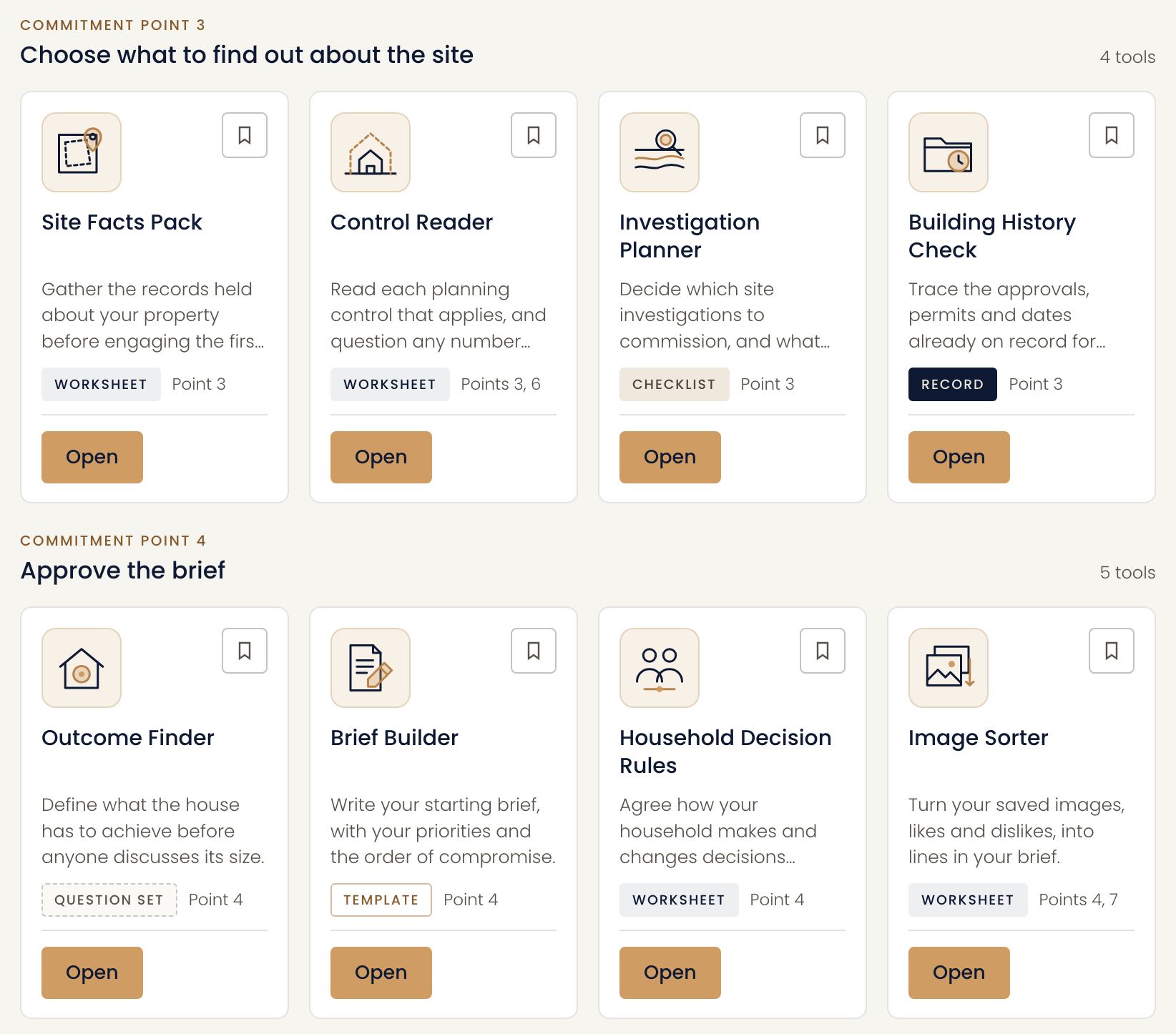
Checklists, templates and planners that apply what you have learnt to your own project, built around the decisions in front of you.
→4. Project Assistant
A dashboard that keeps your place in the program, your saved articles and your templates together, so returning after a few weeks takes a moment.
→Foundations Program
Eight Stages, One Connected Project
The Home Mastery Foundations Program follows a renovation or new home from the first idea to handover, explaining at each stage what is being decided, what it affects later and what to clarify before you commit.
The Foundations Program is built on The Layline Principle. The layline is the line from which one well-timed turn sets a direct course to where you want to arrive. The term comes from sailing, where a boat cannot sail straight into the wind, so to reach a point upwind it sails at an angle to the wind instead. Once it reaches the layline, one last turn points it directly at its destination. Experienced sailors see that line long before they reach it and commit to it at the right moment. A home project is a journey with moments of the same kind.
Starting a home project is a little like setting sail. The first decision sets the course: whether to renovate, rebuild, move or wait. From there the way is rarely a straight line. The conditions you cannot change, such as the site, the planning rules and what you can spend, shape it, in the way the wind shapes a boat's course. A few decisions along the way set where the project arrives, and each is the point where its course meets a layline.
At each of these commitment points, the lessons follow The LOG System: they locate the decision before it arrives, show the part of it that is yours, whether or not you engage a professional, and guide you through what is already fixed, what the home is meant to do and what matters most, while its options are still open. You keep a log of every decision and the reason for it, until the home is handed over.
- 8 StagesIn three phases
- 17 Commitment PointsIn the order they arrive
- Checklists & GuidesPrint or save
The eight stages, in three phases
Select a stage below to see what it teaches and what you finish it with.
Phase 1: Project Planning
Stage 1Choose the Right PathSet the Course of Your Project.Understand your options, and decide whether to renovate, rebuild, improve or take another path.
What You Will Learn
- Identify the underlying problem your home project needs to solve.
- Explore the realistic options, from smaller improvements to renovating, rebuilding or moving.
- Test each pathway against your property, finances, lifestyle and tolerance for disruption.
- Compare the likely compromises, risks and long-term value of each option.
Learning Outcome
- A clear understanding of your realistic project options.
- Confidence to identify the pathway that best fits your circumstances.
- A documented decision, including the investigations still required.
Stage 2Define Your OutcomeYour Brief Is the Seed.Set the priorities, the scope boundaries and what the finished project must achieve.
What You Will Learn
- Turn your preferred pathway into a clear statement of project purpose and success.
- Set priorities, protected outcomes and practical rules for making trade-offs.
- Define what is included, excluded, conditional or still uncertain.
- Explain how the home should function, feel and support your household over time.
Learning Outcome
- A shared understanding of what the project must achieve.
- Clear priorities, scope boundaries and decision rules.
- A usable Homeowner Project Brief for your professional team.
Stage 3Budget, Constraints & Trade-offsThe Real Budget Is a Boundary, Not Just a Number.Set the whole-project budget, understand its constraints, and decide what gives way.
What You Will Learn
- Distinguish the total project budget from the construction budget and contract price.
- Identify the professional, approval, site, finance and household costs beyond the building work.
- Allow appropriately for incomplete information, contingency and known project risks.
- Test whether the project brief fits the available budget and decide what can simplify, reduce or wait.
Learning Outcome
- A responsible understanding of what your household can commit.
- A realistic working budget range, protected reserve and firm ceiling.
- A Project Budget Boundary that can guide design and professional conversations.
Phase 2: Design & Team Setup
Stage 4Shape a Better DesignDesign Is a Chain Reaction.Test the design against everyday life, the site and the budget before it is fixed.
What You Will Learn
- Read early plans and understand what is being proposed beyond the presentation images.
- Test the layout against everyday routines, movement, storage and room use.
- Consider natural light, sun, ventilation, privacy, noise and outdoor comfort.
- Recognise how design decisions can affect cost, approvals, construction and future maintenance.
Learning Outcome
- A clearer understanding of how the proposed design will work in real life.
- Practical, outcome-based feedback for your designer.
- A Design Review and Readiness Decision identifying what can proceed and what must change.
Stage 5Approvals & ComplianceInvisible Decisions Shape the Visible Home.Understand the approval pathway, who is involved, and when a set is ready to price.
What You Will Learn
- Understand the broad approval sequence and the difference between planning and building approval.
- Identify property, site, title and project issues that may alter the pathway.
- Clarify who prepares, reviews, approves and coordinates each part of the process.
- Judge whether the current documents are suitable for approval, pricing or construction.
Learning Outcome
- A clearer picture of the likely approval pathway and unresolved triggers.
- Defined responsibilities, required evidence and document-control arrangements.
- An Approval and Documentation Readiness Pack with a clear next action.
Phase 3: Construction Preparation & Delivery
Stage 6Prepare for ConstructionClarity Before Commitment.Compare builders on the same scope, then prepare to sign and to start well.
What You Will Learn
- Compare builders' quotes using the same scope, documents and assumptions.
- Understand exclusions, allowances and the parts of a price that may still change.
- Assess builder suitability and check that the contract records what has been agreed.
- Prepare critical selections, procurement, the site, your household and project-control systems.
Learning Outcome
- A well-supported decision on the builder and the price.
- Clarity about the contract, price exposure and remaining pre-start actions.
- A Construction Commitment and Pre-Start Pack, including separate decisions about signing and starting.
Stage 7Stay in Control During ConstructionEvery Project Has Control Points.Stay informed, decide on changes in time, and keep a clear record.
What You Will Learn
- Understand your role, the builder’s role and the boundaries around site access and instructions.
- Use a consistent weekly rhythm to track decisions, issues, progress and upcoming actions.
- Assess variations and payment claims before approving or paying them.
- Respond proportionately to delays, hidden conditions and visible quality concerns.
Learning Outcome
- A practical system for staying informed without trying to manage the site.
- Clear records of decisions, changes, payments and unresolved matters.
- Confidence to clarify concerns early and escalate through the appropriate pathway when needed.
Stage 8Completion, Closeout & ProtectionCompletion Is a Sequence, Not a Date on the Calendar.Close out the project in sequence, and protect what you have built.
What You Will Learn
- Understand the difference between practical completion, handover, certification and final payment.
- Inspect and document incomplete work, possible defects, touch-ups and matters needing professional review.
- Collect and organise certificates, drawings, manuals, warranties and other important project records.
- Reconcile the final account and establish warranty, insurance and maintenance arrangements.
Learning Outcome
- A clear record of what is complete, what remains outstanding and who owns each follow-up.
- A better-prepared final-account and payment decision.
- A Completion and Protection Pack that supports warranties, maintenance, insurance and future ownership.
Knowledge Library
Deeper Answers, When the Question Arrives
The Home Mastery Knowledge Library holds short, specific articles that go deeper than the lessons, for the moment a question about your own project arrives, with members' questions answered beside them.
- In-depth ArticlesShort and specific, and able to go deep where the subject needs it.
- Organised by Your StepBrowse by where you are in the project, or search for the term.
- Homeowner Q&AMembers' questions, answered in general terms so every member can use them.
Comparing builders' quotes
how to read scope, exclusions and allowances before comparing totals
- Three interpretations of one scope, in three structures
- The words that carry the exclusions, wherever they appear
- Work a builder cannot quantify is either included or left out
- When the totals are genuinely comparable
For when you are holding two or more quotes
Organised by the six steps of a project
- Step 1Start the Right Project
- Renovate, rebuild or move
- The house you already have
- The site and what is recorded about it
- Choosing who designs
- The brief
- How long a project takes
- Step 2Set the Real Budget
- The budget and the estimates
- Where the money goes
- When the price exceeds the budget
- Step 3Test the Design, Approvals and Documents
- Reviewing and changing the design
- Rooms and their sizes
- Light, warmth and quiet
- Structure and the site
- Services and energy
- What the planning rules allow
- Approvals and their conditions
- Reading the drawings
- Knockdown and demolition
- Step 4Compare Builders, Prices and Contracts
- Choosing how to price, and who builds
- Comparing the quotes
- Allowances and site costs
- Selections
- Signing and starting
- Step 5Stay Informed During Construction
- Payments and changes
- Inspections and the quality of the work
- Concerns and records
- Living with the build
- The programme and delays
- Step 6Complete and Protect the Home
- Completion and handover
- After handover
Toolkits
Apply what you have learnt to your own project.
Templates, checklists and planners built around the decisions at each stage, each item saying what to look for and what to do if it is missing.
- ChecklistsWhat to look for, and what to do if it is missing.
- TemplatesReady-to-use formats for your brief, budget and records.
- PlannersLay out your budget, timeline and decisions in order.
- ToolsCalculators that add up your own figures, and comparison tools for specific decisions.
Project Assistant
Your Place, Kept for You
A building project runs over months, and you will return to the lessons as each decision arrives. The Project Assistant holds your place in the program and keeps the articles and templates you have saved together, so coming back after a few weeks away takes a moment rather than a search.
A free version, holding your Project Map and the articles you save, will open with the Map.
- Track your learningSee what you have completed and what comes next.
- Save favouritesBookmark articles and tools for quick access.
- Keep notesAdd your notes as you learn.
- Your progressSee how far you have come through the program.
Events you may meet: a price over budget, a variation or a delay, a concern about workmanship
Foundations Program
Stage 6 · Prepare for Construction
Recommended
- Comparing builders' quotesArticle
- Checking a builder's licenceArticle
- Quote comparison checklistToolkit
Membership
Membership has not opened yet.
Subscribe below to be notified when it opens.